

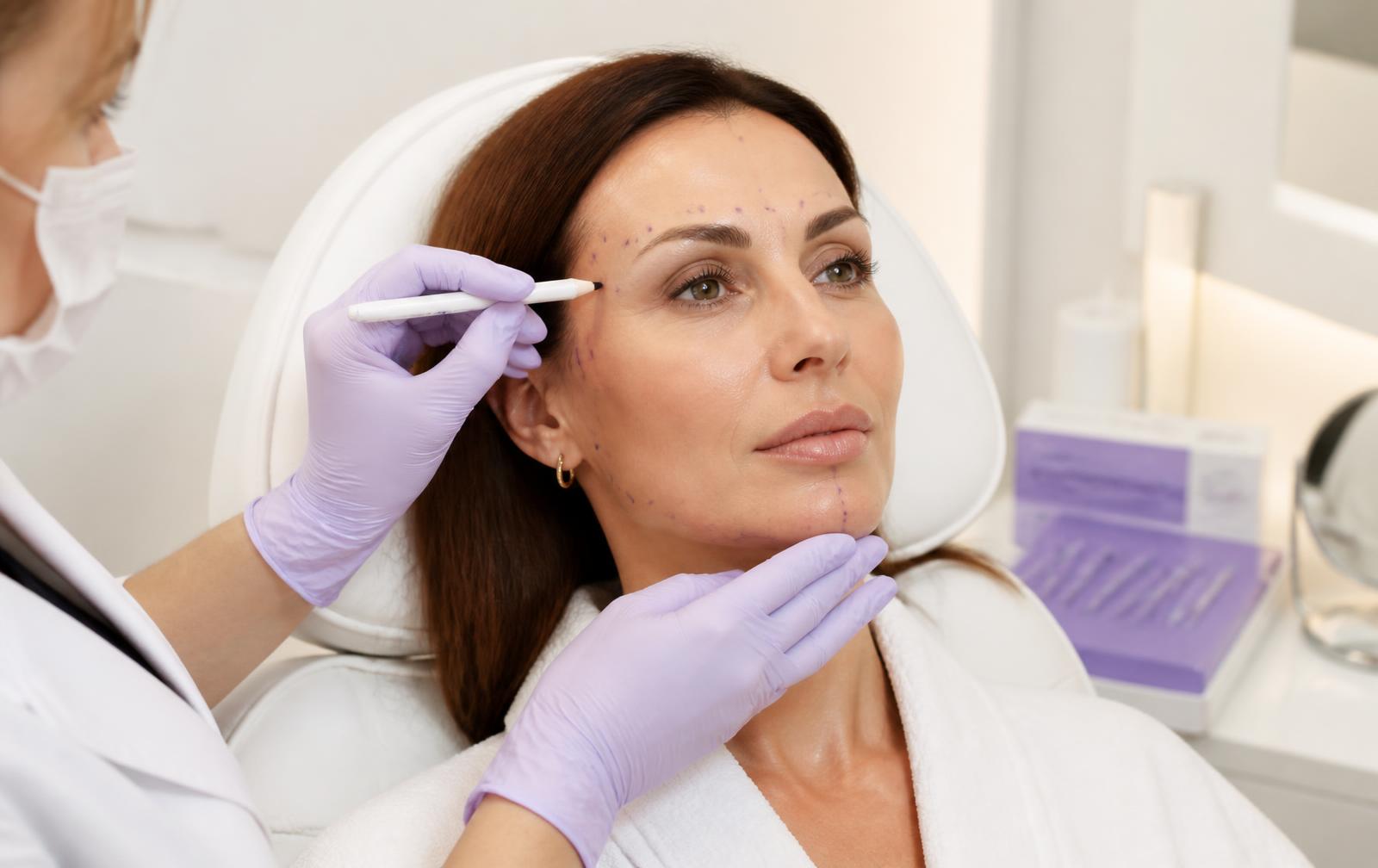
Injectables are only as good as the judgement behind the needle. These are the questions our medical director tells patients to ask before anyone touches their face.
The most difficult consultations we hold are corrections. A filler placed in the wrong plane, a brow frozen asymmetrically, a lip treated without assessing the surrounding structure. Almost all of it is preventable at the point of choosing who performs the treatment — which is why this checklist exists.
1. Who is holding the needle
Ask directly whether the person injecting is a licensed physician, and what their training in facial anatomy consists of. Injectables are medical procedures with vascular risk. Anatomy knowledge, not technique videos, is what prevents occlusion.
2. Whether you were properly assessed
A sound consultation examines the whole face at rest and in movement, discusses your history, and sometimes concludes that the treatment you asked for is not the right one. If someone agrees to everything you request without assessment, that is a warning rather than good service.
“The most valuable thing an injector can say is no. Anyone who never declines a request is selling product, not practising medicine.”
3. Product traceability
- The product should be opened in front of you, never pre-drawn in a syringe
- You should be told the exact brand and, for fillers, the specific range and volume used
- Batch details belong in your clinical record and should be available on request
- Unbranded or unusually cheap product is the single most common cause of serious complications
4. How complications are handled
Ask what happens if something goes wrong. A clinic treating injectables medically will have hyaluronidase on site for filler emergencies, a written aftercare pathway, and a named clinician reachable after hours. If those answers are vague, so is the safety net.

5. Pricing that makes sense
Injectables priced far below the market usually mean diluted or uncertified product, or an unqualified injector. Transparent per-unit and per-syringe pricing, given in writing before treatment, is the standard to expect. At New Me every quote is confirmed at consultation before anything is administered.
What a good outcome looks like
Movement retained, expression intact, symmetry respected and a result that develops over two weeks rather than announcing itself on day one. Conservative dosing, reviewed at fourteen days, consistently outperforms treating everything in one session.
Frequently asked
How long should a first injectable consultation take?
At least thirty minutes, including assessment, medical history, photography and a written plan and quote.
Is a review appointment necessary?
Yes. We review botulinum toxin at two weeks so any refinement is done precisely rather than guessed at the first session.
Can filler be dissolved if I dislike it?
Hyaluronic-acid fillers can be dissolved with hyaluronidase. This is one reason we do not use permanent or semi-permanent fillers.
Is this article a substitute for a consultation?
No. This article is educational. Treatment decisions at New Me are made after an in-person skin assessment, medical history review and, where relevant, imaging or patch testing.
Related treatments
- Botulinum toxin consultation
Conservative dosing, two-week review
- Dermal filler assessment
Full-face planning, HA products only
- Collagen biostimulators
Gradual structural support
Related products
Post-injectable arnica gel
Reduces bruising in the first 48 hours
Peptide recovery serum
Supports skin between sessions
About the author
Dr. Mariam Fouad
Medical Director, New Me Aesthetics & Wellness Clinic
Dr. Mariam Fouad leads the medical team at New Me in Mohandessin, with a practice built around evidence-based dermatology and conservative, natural-looking aesthetic outcomes. She consults personally on every injectable and laser protocol prescribed at the clinic.